Why recruitment businesses fail between Front Office and Back Office
Front Office wins the work. Back Office bills the work. The business breaks in the middle — when handovers are weak, ownership is unclear, and the placement journey is split across tools, inboxes and teams.
Blog: Why recruitment businesses fail between Front Office and Back Office
Recruitment businesses rarely fail because they cannot find talent. They fail because delivery and commercial control do not stay connected.
Recruitment leaders often diagnose the wrong problem.
When growth stalls, the first questions are usually:
- Do we need more recruiters?
- Do we need a better ATS?
- Do we need more candidates?
Sometimes those matter. Often, the real failure is elsewhere.
It happens in the space between Front Office and Back Office — after demand is won, and before revenue is cleanly realised.
Recruitment businesses rarely fail because they cannot find talent. They fail because delivery and commercial control do not stay connected.
What Front Office and Back Office actually do
In a recruitment business:
Front Office is where demand is won and talent is moved: clients, jobs, candidates, submissions, interviews, offers.
Back Office is where value is protected and collected: timesheets, POs, invoices, AR, leakage controls, commercial closure.
Between them sits the work that decides whether a placement becomes a clean commercial outcome:
- Onboarding readiness
- Compliance and documentation
- Join confirmation
- Workforce activity capture
- Handover discipline
- Renewal and change control
That middle zone is where many businesses quietly break.
The failure pattern: win in Front Office, leak before Back Office
A common sequence looks like this:
- Sales or account teams win a role
- Recruiters fill it quickly
- Everyone celebrates “placed”
- Then the process fragments
Suddenly:
- Compliance packs are chased by email
- Join dates slip without clear ownership
- Timesheets start late or incomplete
- PO cover is unclear or expired
- Finance cannot invoice cleanly
- Delivery says “done,” finance says “not ready”
Front Office thinks the job is finished. Back Office is still fighting to make it billable.
That gap is expensive.
Why the middle breaks
“Placed” is treated as the finish line
In recruitment businesses, placement is a handover point — not the end of the journey.
Systems are split by department
ATS for recruiters. Spreadsheets for compliance. Separate tools for timesheets and invoicing. No single placement spine.
Ownership disappears in transition
Who owns join readiness, first timesheet, or PO validity? If the answer is “depends,” leakage follows.
Client-specific rules stay in people’s heads
Billing rules, document requirements and approval paths differ by client — but live in chat threads, not controlled workflows.
Middle Office is underbuilt
Many teams invest in Front Office speed and Back Office finance, but underinvest in the operating layer that connects them.
Front Office vs Back Office vs the missing connection
| Layer | Focus | What success looks like | Where it fails alone |
|---|---|---|---|
| Front Office | Win demand + deliver candidates | Fill roles fast | Stops at “placed” |
| Middle connection | Make placements operable | Ready to start + controlled handover | Often informal / manual |
| Back Office | Realise and protect revenue | Clean invoice + margin control | Gets incomplete inputs |
The business does not need only stronger ends. It needs a stronger bridge.
What “good” looks like between Front and Back Office
A connected recruitment business platform treats the placement as one record across teams:
- Controlled intake from Front Office — demand enters with ownership, client context and commercial terms.
- Delivery with a clear placement trail — candidate movement remains visible through offer and confirmation.
- Middle Office readiness — onboarding, compliance and join checks are part of the same journey.
- Clean commercial handover — timesheets, PO cover and billing rules attach before invoice pressure starts.
- Back Office execution with evidence — finance invoices from connected delivery data, not reconstructed history.
That is how Front Office wins and Back Office collects — without the middle becoming a black hole.
The commercial cost of the gap
When Front Office and Back Office are disconnected, leaders usually see:
- Delayed invoicing
- Revenue leakage from timesheet/PO gaps
- Compliance surprises near join date
- Recurring firefighting between teams
- Lower trust between delivery and finance
- Growth that increases chaos instead of margin
Fill rate can still look healthy. Cash flow and control may not.
That is why recruitment performance cannot be judged by hiring metrics alone.
Hire to Retire and Requisition to Revenue close the same gap
These two operating views exist for one reason: to stop the business breaking in the middle.
- Hire to Retire keeps the talent and delivery lifecycle connected
- Requisition to Revenue keeps the commercial path from demand to billing connected
Together, they force Front Office, Middle Office and Back Office to work as one engine.
That is the difference between an ATS mindset and a recruitment business platform mindset.
A practical checklist for leaders
- Where does ownership go after “candidate placed”?
- Are compliance and onboarding linked to the same placement record as hiring?
- Can finance invoice without reconstructing delivery evidence?
- How often do PO, timesheet or join issues delay revenue?
- Do Front Office and Back Office share one workflow — or just one company name?
If the answers expose a gap, your biggest risk is not sourcing. It is operating fragmentation.
Bottom line
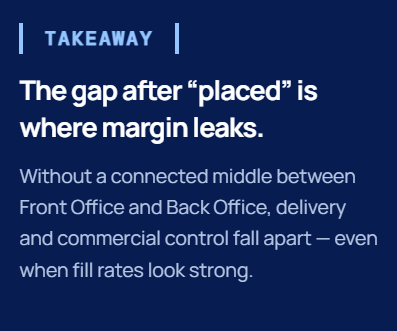
Recruitment businesses fail between Front Office and Back Office when placement is treated as an ending instead of a handover.
Front Office can win demand. Back Office can process invoices. But without a connected middle, delivery quality and revenue control both erode.
The winners will not be the teams with the most candidate activity. They will be the teams that keep demand, delivery, compliance and billing on one spine — from first requisition to realised revenue
Want to close the Front-to-Back gap?
See how PulseWin connects demand, delivery, compliance and billing on one operating spine.
Book a Demo