Requisition to Revenue: connecting hiring to billing
Winning a role is only the start. Revenue is realised when delivery, timesheets, purchase orders and invoices stay connected. Requisition to Revenue is how recruitment businesses turn hiring activity into controlled commercial outcomes
Blog -Requisition to Revenue: connecting hiring to billing
Requisition to Revenue connects the work you win to the revenue you actually collect.
Most recruitment teams measure activity: jobs opened, candidates submitted, interviews booked, offers accepted.
Fewer teams can clearly answer this:
When does a requisition become revenue — and where does money leak on the way?
That is what Requisition to Revenue is designed to make visible.
In a recruitment business, the commercial journey does not end at hiring. It runs from client demand through delivery and into billing, collections and margin protection.
Requisition to Revenue connects the work you win to the revenue you actually collect.
What Requisition to Revenue means
Requisition is the controlled start of demand: a client need captured as an actionable requirement. Revenue is the commercial result: clean billing supported by delivery evidence, PO cover and invoice readiness.
Between those two points sit the stages that make or break profitability:
- Job intake and approval
- Sourcing, screening and submission
- Offer and joining
- Timesheets and attendance
- Quotes, purchase orders and invoices
- AR follow-through and leakage control
If these stages are disconnected, hiring can look successful while finance still struggles.
Why hiring and billing get disconnected
In many recruitment businesses, the break happens after “placed.”
Common gaps include:
- Timesheets delayed or incomplete
- PO expired or not linked to the placement
- Invoice raised without full delivery evidence
- Client-specific billing rules sitting in email threads
- Renewals changing commercial terms without system updates
The result is familiar: delivery teams say the work is done, finance says the invoice cannot go out, and leadership sees cash flow risk without a clear owner.
Requisition to Revenue fixes that by treating commercial control as part of the same journey — not a separate afterthought.
The Requisition to Revenue path
A practical model looks like this:
Controlled job intake
Demand enters with ownership, client terms and commercial context — not as an unstructured request.
Delivery with visibility
Candidates move through screening, submission, interview and offer with a clear placement trail.
Ready-to-start handover
Onboarding and compliance readiness protect the start date and reduce downstream billing disputes.
Workforce activity capture
Timesheets and delivery evidence are linked to the placement, not parked in spreadsheets.
Commercial confirmation
Quotes, PO cover and billing rules stay attached to the same record.
Invoice and AR control
Invoicing follows evidence. Leakage alerts help catch gaps before margin quietly disappears.
That is how hiring becomes billable work — and billable work becomes collected revenue.
Requisition to Revenue vs hiring-only operations
| Stage | Hiring-only view | Requisition to Revenue view |
|---|---|---|
| Demand | Job opened | Controlled requisition with commercial context |
| Delivery | Candidate placed | Placement linked to client terms and workflow |
| After joining | Handed to another team | Timesheets and delivery evidence continue |
| Finance | Separate process | PO, invoice and AR connected to placement |
| Risk | Found late | Leakage spotted earlier |
| Success | Fill rate | Fill rate + invoice readiness + margin protection |
Why this matters for contingent and staffing models
For contingent workforce and staffing businesses, revenue depends on continuous delivery evidence — not a one-time hire event.
That means:
- Every active placement needs clean timesheet flow
- Every invoice needs valid commercial cover
- Every renewal can change billing conditions
- Every leakage point can erode margin silently
Requisition to Revenue gives leaders one commercial spine across that lifecycle.
How it connects to Hire to Retire
These two views work together:
- Hire to Retire follows the talent and delivery lifecycle
- Requisition to Revenue follows the commercial path from demand to billing
Together, they describe the full recruitment business engine:
Win demand → deliver talent → stay compliant → realise revenue.
That is why PulseWin is positioned as a recruitment business platform — connecting front office, middle office and back office in one workflow.
A practical checklist
- Can we see which open requisitions are commercially ready to bill later?
- Are timesheets, POs and invoices linked to the same placement record?
- How often do invoices wait because delivery evidence is incomplete?
- Do we catch PO expiry and leakage before cash flow is hit?
- Can leadership trace a role from intake to invoice without switching systems?
If the answers are weak, you have a hiring process — but not a complete Requisition to Revenue operating model.
Bottom line
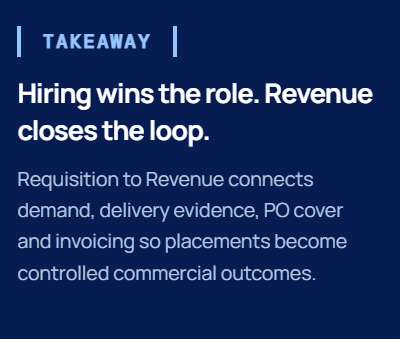
Requisition to Revenue is how recruitment businesses connect hiring activity to commercial outcomes.
It turns placements into controlled billing, protects margin from silent leakage, and gives leaders visibility from client demand all the way to invoice.
Because in recruitment, winning the role is only half the job. Realising the revenue is the other half.
Want to connect hiring to billing?
Walk through Requisition to Revenue with the PulseWin team — from job intake to invoice readiness.
Book a Demo